



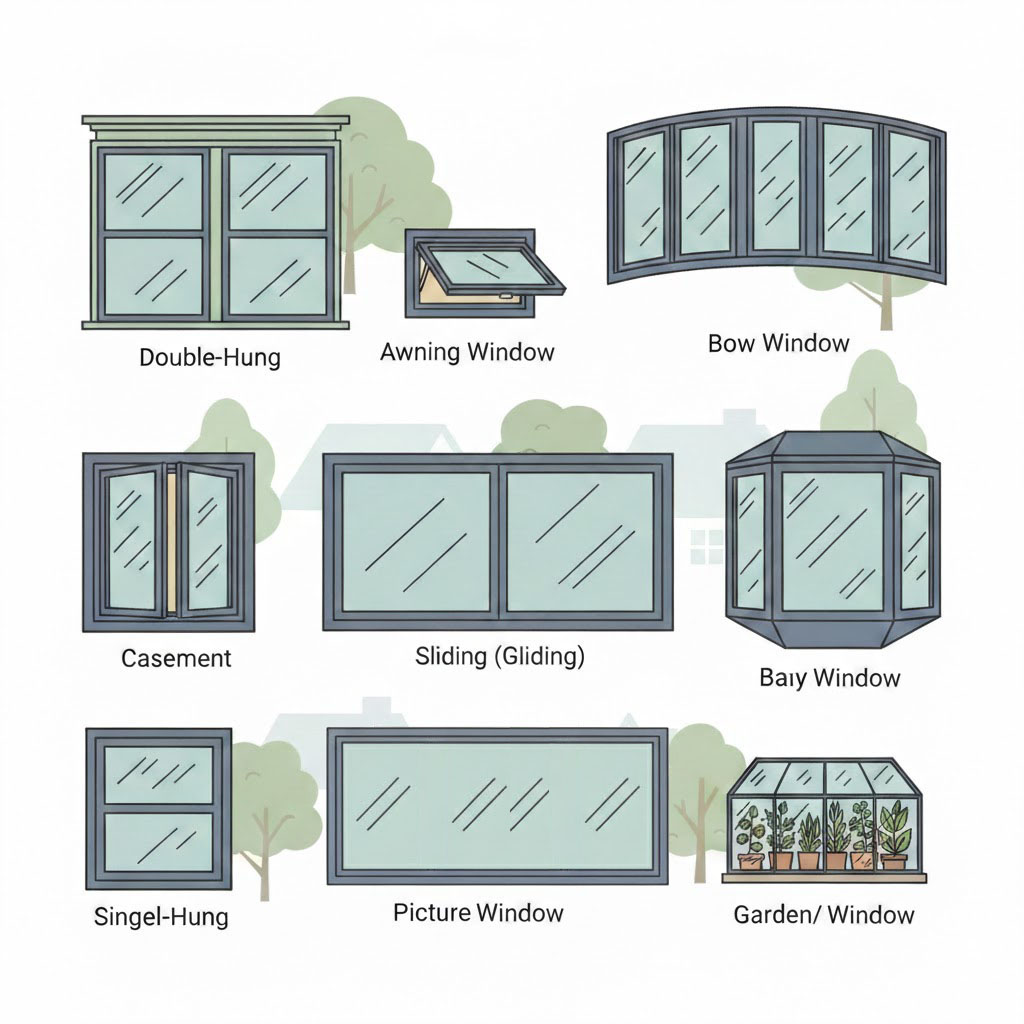
Know Your Window Types
Windows do more than let in light—they define the character of your home, control ventilation, boost energy efficiency, and frame your favorite views. At Urban Edge Homes, we work closely with every client to select the right window styles that perfectly match their lifestyle, architecture, and budget. Whether you’re dreaming of a modern farmhouse or a classic colonial, understanding the different types of windows helps you make informed choices.
Below, we break down the most popular residential window types with clear explanations of how they operate.
1. Double-Hung Windows
These classic favorites feature two movable sashes (the framed glass panels) that slide vertically. You can open the bottom sash for a breeze or raise the top sash to let hot air escape—ideal for natural circulation. Both sashes often tilt inward for easy cleaning.
Best for: Traditional and transitional homes, bedrooms, and living areas where versatile airflow matters.
[Black-and-white line drawing of a double-hung window showing two vertically sliding sashes with a tilt-in mechanism indicated]
2. Single-Hung Windows
Very similar to double-hung, but only the bottom sash moves up and down while the top remains fixed. They offer the same timeless look at a slightly lower cost and with less maintenance.
Best for: Kitchens above sinks, high-traffic areas, or budgets where top ventilation isn’t essential.
[Black-and-white line drawing of a single-hung window showing the bottom sash operable and top sash fixed]
3. Casement Windows
Hinged on one side like a door, these swing outward when you turn a crank handle. They provide unobstructed views and maximum ventilation because the entire pane opens.
Best for: Kitchens (above sinks), tight spaces, or anywhere you want a modern, clean look with excellent airflow and energy efficiency.
[Black-and-white line drawing of a casement window shown swung open on side hinges with crank operator visible]
4. Awning Windows
Hinged at the top, these tilt outward from the bottom via a crank. They act like a small awning, allowing ventilation even during light rain.
Best for: Basements, bathrooms, or stacked above picture windows for added light without weather worries.
[Black-and-white line drawing of an awning window tilted outward from the bottom with top hinge shown]
5. Sliding (Gliding) Windows
One or both large panels slide horizontally on a track. They require no outward swing space and offer wide, unobstructed openings.
Best for: Modern homes, patios, family rooms, or areas needing easy egress and panoramic views.
[Black-and-white line drawing of a sliding window with one panel shown shifted horizontally along the track]
6. Picture Windows (Fixed Windows)
Large, stationary panels that do not open. They maximize natural light and views with minimal framing for a “picture-perfect” effect.
Best for: Living rooms, dining areas, or any wall where you want maximum sunlight and drama—often paired with operable windows for ventilation.
[Black-and-white line drawing of a large fixed picture window with thin framing and no visible operators]
7. Bay Windows
These project outward from the wall in a polygonal shape (usually three panels: a large fixed center with operable sides at angles). They create charming interior nooks and extra space.
Best for: Living rooms, bedrooms, or breakfast nooks where you want seating, storage, or a cozy reading spot with 180° views.
[Black-and-white line drawing of a three-panel bay window projecting outward with angled side panels]
8. Bow Windows
Similar to bay windows but with four or more panels forming a gentle, curved arc. They create a smoother, more dramatic projection and even more interior space.
Best for: Elegant formal rooms or facades needing graceful curb appeal and abundant light.
[Black-and-white line drawing of a four-panel bow window forming a smooth curved projection]
9. Garden (Greenhouse) Windows
These box-like projections extend outward with glass on three or five sides, creating a mini greenhouse shelf for plants. Often fixed or partially operable.
Best for: Kitchens or sunrooms where you want to grow herbs, display plants, or bring the outdoors in.
[Black-and-white line drawing of a garden window projecting outward like a small box with glass on top, front, and sides]
Choosing the Right Windows for Your Custom Home
Every home is unique—that’s why we never use a one-size-fits-all approach. Factors we consider together include:
- Climate & Energy Efficiency — Casement and awning styles often seal tighter.
- Maintenance — Tilt-in double-hung or sliding for easy cleaning.
- Aesthetics — Mixing styles (e.g., picture windows flanked by casements) creates stunning facades.
- Function — Ventilation needs, views, privacy, and egress codes.
In our custom builds, we help clients combine these types seamlessly—perhaps a dramatic bow window in the great room with energy-efficient double-hung units throughout the bedrooms.
Ready to bring your vision to life? Contact our team today for a personalized window consultation. We’ll guide you through every option so your new home not only looks incredible but performs beautifully for years to come.


